By Al Johnson
“he will be great before the Lord” —Luke 1:15
Before John the Baptist was ever born, the angel Gabriel announced that his life would be significant. Zechariah and Elizabeth had spent years longing for a child, and now, in their old age, God had answered their prayer. Gabriel told Zechariah that he would have joy and gladness and that many will rejoice because of the birth of John (Luke 1:14). For Zechariah and Elizabeth, John’s birth would bring an end to a lifetime of longing and waiting. For all of God’s people, John would be the fulfillment of generations of longing and waiting. God was raising up the promised messenger who would prepare the way for Jesus Christ.
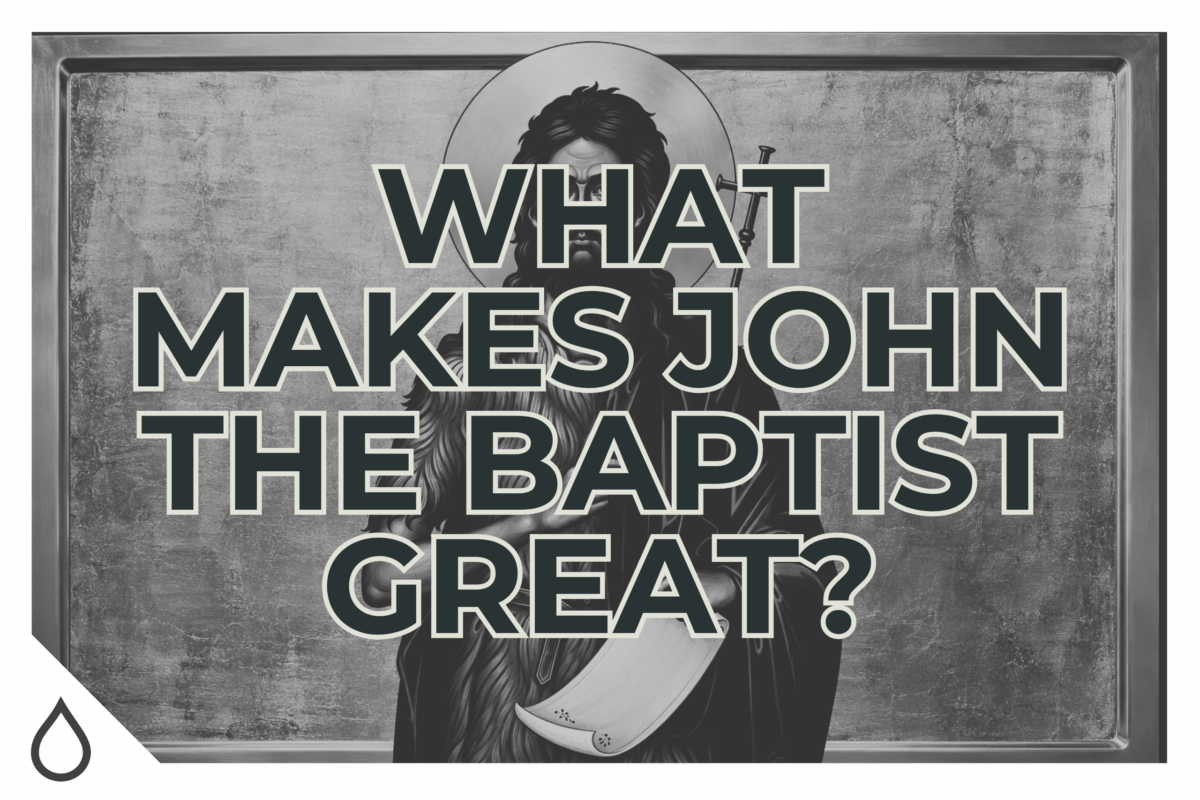
Not only did the angel Gabriel foretell the greatness of John, but the Lord Jesus Himself would later say of him, “among those born of women none is greater than John” (Luke 7:28). Throughout the Gospel of Luke, this theme of greatness will be revisited. Lord willing, as we continue through Luke, my aim is to help us understand greatness according to God and His Word rather than according to our culture. This must become a consistent conviction for those of us who desire to become the kind of people God created us to be. We must reject our rebellious culture’s definition of greatness because it offers us a counterfeit. But we should not reject the pursuit of greatness altogether.
Jesus did not tell us that John was great so that we could simply remember it as something interesting He once said about him. John’s life gives us an example of the kind of greatness God esteems and should cause us to ask what we can learn from the man Jesus called great. That raises an important question: What made John the Baptist great?
Our world has plenty of ways of measuring greatness. We measure men by wealth, accomplishments, influence, power, platforms, and how many people know their names. John possessed very little of what the world typically associates with greatness in terms of wealth or comfort. He lived an ascetic life in the wilderness, preached a message of repentance, confronted powerful people, and eventually lost his life because he refused to compromise the truth.
Yet we should not make the mistake of thinking that John was insignificant or lacked influence. He accomplished something of extraordinary magnitude: he prepared the way for Jesus Christ. Large crowds came from Jerusalem, Judea, and the surrounding region to hear him preach and be baptized (Matt. 3:5–6). His influence became so significant that his reputation reached Herod Antipas, the tetrarch who ruled Galilee.
Mark tells us that even after John confronted Herod over his sinful marriage, Herod feared him because he knew that John was “a righteous and holy man.” Herod protected him for a time and, remarkably, “when he heard him, he was greatly perplexed, and yet he heard him gladly” (Mark 6:20).
John, then, had influence. He had a following. He was known by the crowds and recognized by rulers. God used him to accomplish something of enormous significance. But none of those things, by themselves, explain why Jesus called John great. They were fruits of John’s calling, not the foundation of his greatness. To understand what made John great before God, we have to look deeper at the kind of man John was and the life God called him to live.
FILLED WITH THE HOLY SPIRIT
The angel Gabriel first tells Zechariah that John would be “filled with the Holy Spirit, even from his mother’s womb” (Luke 1:15). Before John preaches a sermon, baptizes anyone, confronts Herod, or points anyone to Jesus, we are told that the Holy Spirit will be upon him. John’s greatness will not ultimately come from his natural ability, personality, courage, or charisma. God will empower him for the work God has called him to do.
There is something here that we cannot afford to miss if we want to be faithful to Jesus and live our lives on mission with Him. Talent can draw attention. Charisma can gather people. Intelligence can impress them. Hard work and discipline really do matter. But none of those things can accomplish what only the Holy Spirit can do. Paul reminds us that God “is able to do far more abundantly than all that we ask or think, according to the power at work within us” (Ephesians 3:20). God can accomplish far more through a life empowered by His Spirit than we could ever accomplish in our own strength.
One of my favorite preachers, Charles Haddon Spurgeon, understood this well. Spurgeon carried an extraordinary workload and was known to work as many as eighteen hours a day. The missionary David Livingstone once asked him, “How do you manage to do two men’s work in a single day?” Spurgeon famously replied, “You have forgotten that there are two of us.”1 Spurgeon understood that for all his hard work, discipline, and natural gifting, he was not laboring alone. The power to accomplish the work God had entrusted to him came from God Himself.
Certainly, John the Baptist would accomplish much through his preaching. Crowds would come to hear him, sinners would be called to repentance, and people would be prepared to receive Jesus Christ. But ultimately, God would be the One at work through him. John was great before the Lord because his life belonged to God and was empowered by the Spirit of God.
TURNING PEOPLE BACK TO THE LORD
John’s ministry would have a clear purpose: “he will turn many of the children of Israel to the Lord their God” (Luke 1:16). John was sent to call people to repentance, turning their hearts back to the Lord. Some of the people who heard John preach belonged to the covenant people of Israel but had wandered far from God. They knew the Scriptures, participated in the religious life of Israel, and could trace their ancestry back to Abraham, but their hearts were far from the Lord. John would call them to repent and return to God.
This is one of the marks of faithful ministry. The goal is never to make people increasingly dependent upon the preacher, impressed by the preacher, or devoted to the preacher. The goal is to turn people toward God. John understood this better than almost anyone. Later, when his disciples became concerned that people were leaving John and going to Jesus, John responded, “He must increase, but I must decrease” (John 3:30). John understood that the success of his ministry would ultimately mean people looking past him and looking to Jesus.
This is still the goal of Christian ministry. Pastors, churches, parents, and Christians are not called to build lives in which we become the center. We are called to point beyond ourselves to the Lord Jesus. In fact, this is what made John the Baptist great. Jesus was the point and purpose of his ministry. If people think much of us but little of Jesus, we have failed. John’s greatness was seen in his willingness to decrease so that Christ would increase.
THE SPIRIT AND POWER OF ELIJAH
John the Baptist would carry out an Elijah-like ministry (Luke 1:17). Like Elijah, John would be a wilderness man. He would live an ascetic life, removed from the comforts that soften most men, wearing camel’s hair and eating locusts and wild honey. Elijah had lived much the same way. He spent long stretches in the wilderness, drank from a brook, was fed by ravens, and was described as a hairy man who wore a leather belt around his waist (1 Kings 17:2–6; 2 Kings 1:8). Neither Elijah or John were formed in the comfort of a palace. God forged them in hard places and then sent them to confront kings.
Elijah’s ministry took place during one of the darkest periods in Israel’s history. Ahab and Jezebel had dragged God’s people deep into idolatry and sexual corruption. Ahab built a temple and altar to the demon Baal, the fertility god worshiped by the surrounding nations, while Jezebel hunted down the prophets of the LORD and had them killed (1 Kings 16:31–33; 18:4). God’s people had abandoned the living God for idols, embracing the sexual perversion bound up with pagan worship, and spilling the blood of God’s prophets. The Scriptures would later describe the spiritual reality behind pagan sacrifice plainly: what the nations sacrificed to idols, they sacrificed to demons (Deuteronomy 32:17; 1 Corinthians 10:20).
Elijah lived in a culture not so different from ours in this respect: people who belonged to God were being pulled toward the gods of the culture around them. Elijah refused to go with them. He would not bend before Ahab, Baal, or the spirit of his age. John would come with that same kind of steel in him—the same prophetic courage, the same willingness to stand alone, and, most importantly, “the spirit and power of Elijah” (Luke 1:17).
John the Baptist came out of the wilderness preaching repentance, calling sinners to turn from their sin because the Lord was coming. He did not reserve that message for only those of the house of Israel but called all men to repentance, even Herod Antipas, who was sleeping with Herodias, his brother’s wife, and eventually took her as his own wife.
John’s preaching would eventually lead to his death. At a drunken birthday feast, after Herodias’s daughter danced before Herod and his guests, Herod made a reckless oath, and Herodias seized the opportunity she had been waiting for. She demanded John’s head. Herod gave the order. An executioner entered John’s prison, cut off his head, placed it on a platter, and delivered it to the girl, who carried it to her mother (Mark 6:21–28).
John did not decide that sexual sin was too controversial to address, as many preachers in our day have. We need men with the same stones John had. And for those who do not, may John become an example of the kind of greatness we must pursue. If you are going to preach God’s Word, count the cost. If you are a coward, the pulpit is not for you. All of us who preach need the Spirit and power of God—the Holy Spirit—to give us boldness and drive the cowardice out of us.
TURNING THE HEARTS OF FATHERS TO THEIR CHILDREN
After centuries without a prophet in Israel, Gabriel announces that a messenger is coming to prepare the people for the arrival of the Lord. In fact, the final words of the Old Testament were about John the Baptist, and now they were being fulfilled. John would come “to turn the hearts of the fathers to the children” (Luke 1:17; Malachi 4:5–6).
When God changes a man’s heart, that change begins showing up in the relationships and responsibilities God has entrusted to him. One of the effects of John’s ministry would be fathers turning their hearts toward their children. Fathers who have been consumed with themselves begin turning toward their children. Men who have been passive begin taking responsibility. Men who have been absent become present. Men begin to desire again the good work of being fathers and faithfully raising the children God has entrusted to them.
John’s ministry would produce repentance that could be seen in the home. The same should be true among us. A man’s relationship with God should affect the way he loves his wife, raises his children, does his work, handles his money, uses his strength, and carries the responsibilities God has given him. The gospel does not leave the rest of our lives untouched.
SINNERS GETTING SAVED
John would also turn “the disobedient to the wisdom of the just” (Luke 1:17). In other words, sinners would be saved. People who had lived far from God, who had neither worshiped Him nor obeyed Him, would turn to the one true and living God. John the Baptist’s preaching would speak directly to people living in open rebellion against God and call them to repent and walk uprightly according to God’s Word, will, and ways. John would not look at the wild disobedience of his day and search for ways to affirm it, excuse it, or rename it. He would call sin what God called it, tell sinners the truth, and call them to turn to the Lord.
This is still one of the great miracles God performs. A person can spend years resisting God, rejecting His Word, justifying sin, and building an entire life around his or her own desires. A man can love the darkness and want absolutely nothing to do with God. Then the Holy Spirit opens his blind eyes. Suddenly, he sees God differently. He sees his sin differently. He sees himself differently. The sin he once defended he now wants to put to death. The God he once ignored he now wants to worship. The Word he once rejected he now wants to obey. That is repentance. That is conversion. That is a miracle of God.
PREPARED FOR JESUS
Ultimately, John the Baptist’s entire life was meant to point people to Jesus, and this is at the heart of what made him great. Gabriel said that John would come “to make ready for the Lord a people prepared” (Luke 1:17). John was the messenger sent ahead of Jesus to sound the alarm, calling people to repentance, and preparing them to receive Jesus Christ.
Everything we have seen about John moved toward this great purpose. When Jesus arrived, John understood exactly what his role was. He was not there to compete with Jesus, protect his own following, or hold on to his influence. When people began leaving John to follow Jesus, John said, “He must increase, but I must decrease” (John 3:30).
In that sense, the ministry of the church today bears a striking resemblance to the ministry of John the Baptist. We are not preparing the world for Christ’s first coming as John did. Jesus has already come. He lived without sin, died for sinners, rose from the grave, ascended into heaven, and now reigns as King. But this same Jesus has promised that He will come again. Until He does, we have been entrusted with the task of proclaiming Him, calling sinners to repentance and faith, and making disciples who are prepared to meet their King.
We desperately need those who will pursue this kind of greatness that John possesses. The church does not need people who stick a finger in the air to see which way the culture is blowing before deciding what they are willing to believe or say. We need people filled with the Holy Spirit, anchored to the Word of God, who fear God more than they fear men. So pursue greatness, but pursue the greatness God calls great. Live in such a way that when your life is over, the great accomplishment is not that people knew your name, but that through your life they came to know His.
1Eric W. Hayden, “Charles H. Spurgeon: Did You Know?,” Christian History, no. 29 (1991).